The Ultimate E-Commerce Fulfilment Guide for UK Furniture Retailers
The Ultimate E-Commerce Fulfilment Guide for UK Furniture Retailers
Online furniture retail offers opportunities for UK businesses. However, delivering a positive customer experience goes beyond accepting online orders. Retailers must coordinate stock, order processing, warehouse operations and delivery scheduling. e-commerce fulfilment UK is a key enabler for moving bulky products.
For businesses selling sofas, beds, wardrobes, dining tables and home accessories, these tasks can become increasingly complex. As order volumes grow, e-commerce fulfilment UK helps manage the complexity.
This is where professional e-commerce fulfilment UK can help.
Moreover, a suitable logistics partner helps furniture retailers organise key fulfilment activities and focus on sales and growth.
In this guide, we explain how e-commerce fulfilment works, what furniture retailers should consider when choosing a provider and how integrated logistics services can support their operations.
What Is E-Commerce Fulfilling?
E-commerce fulfilment is the process of managing customer orders from the point an order is received through to dispatch and delivery.
Depending on the service agreement, fulfilment may include receiving stock, recording inventory, storing products, picking and preparing orders, coordinating transportation and managing delivery information.
For furniture retailers, E-commerce fulfilment UK can require planning because many products are large, heavy, fragile or difficult to move.
A suitable fulfilment arrangement should reflect the retailer’s product range, storage requirements, order volumes and delivery promises.
Why Furniture Retailers Need a Different Fulfilling Approach
Small parcels can often be processed through standard parcel networks. Bulky furniture may require different vehicles, additional handling and coordinated delivery teams.
Retailers should consider several operational challenges.
1. Managing bulky inventory
Furniture products can occupy considerable warehouse space. Poor stock visibility can lead to overselling, delayed dispatches and avoidable customer inquiries.
Accurate inventory records help businesses understand which products are available, which orders have been allocated and when stock needs replenishing.
2. Preparing orders for safe transportation
Furniture can be vulnerable to scratches, broken components and packaging damage. Appropriate packaging, product checks and careful handling are important throughout the fulfilment process.
Retailers should establish how products are inspected, prepared and protected before dispatch.
3. Coordinating final-mile delivery
The final stage of delivery can be particularly important for large household products. Customers may need an agreed delivery slot, access arrangements or a service that takes the item into their property.
A logistics partner offering suitable two-man delivery options can help retailers coordinate these requirements.
4. Keeping customers informed
Customers want clear information about order progress and delivery arrangements. Retailers need an agreed process for notifications, delays, rescheduling and delivery confirmation.
Good communication can reduce uncertainty and help customer service teams manage inquiries more effectively.
How Professional E-commerce fulfilment UK Works
Although processes vary between providers, a typical fulfilment operation can include the following stages.
Step 1: Receiving and checking stock
Products arrive at the warehouse and are checked against the relevant delivery or stock records. Any discrepancies or visible damage should be documented and addressed according to the agreed procedure.
Step 2: Recording inventory
Stock quantities and product details are recorded so the retailer can maintain visibility of available inventory.
The precise reporting frequency and system access should be agreed with the fulfilment provider.
Step 3: Processing customer orders
When an order is received, the fulfilment team follows the agreed process for identifying the product, confirming availability and preparing it for dispatch.
Order integration, manual processes and reporting arrangements vary between providers.
Step 4: Preparing products for dispatch
Products are prepared for transportation using suitable packaging and handling procedures. Furniture may require additional protection because of its dimensions, materials and finish.
Step 5: Coordinating delivery
The order is assigned to an appropriate delivery service. For bulky furniture, this may involve specialist transport or a two-person delivery team.
Delivery scheduling and customer communication should follow the retailer’s agreed service requirements.
Step 6: Confirming delivery
Delivery confirmation and exception reporting help retailers understand whether orders have been completed successfully and identify issues requiring follow-up.
A clear process also makes it easier to investigate delays, damage claims and customer complaints.
Benefits of Outsourcing Fulfilling
Outsourcing fulfilment is not automatically the right choice for every business. However, it may be useful for furniture retailers that want to reduce the operational burden of managing stock and deliveries internally.
More time to focus on sales
Managing warehousing and dispatch can take time away from marketing, merchandising, customer service and product development.
A suitable external partner can take responsibility for agreed operational activities, allowing the retailer to focus on its core business.
Better coordination between stock and delivery
When inventory records, order processing and delivery planning follow a clear workflow, businesses can make more informed operational decisions.
Retailers should assess how the provider shares stock information and handles discrepancies.
Access to specialist delivery services
Furniture retailers may need more than standard parcel delivery. Depending on the provider, additional options can include two-man delivery, room-of-choice placement, unpacking and assembly.
These services should be selected according to the products sold and the expectations of the target customer.
Support for changing order volumes
Seasonal demand, promotions and business growth can change the amount of fulfilment work required.
Before outsourcing, retailers should confirm how the provider handles peak periods, additional storage requirements and changes in order volume.
A more organised customer experience
Clear booking procedures, realistic delivery commitments and consistent communication can help retailers manage customer expectations.
Fulfilling performance should be reviewed regularly rather than assumed to improve simply because operations have been outsourced.
Why Two-Man Delivery Matters for Furniture E-Commerce
For many furniture retailers, final-mile delivery is one of the most important parts of the customer journey.
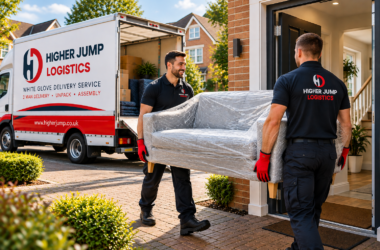
A two-man delivery service uses a two-person team to handle and transport suitable products. The service can be particularly relevant for sofas, wardrobes, beds and other bulky items.
Depending on the provider and service level, retailers may also be able to arrange:
- Delivery into the customer’s property
- Room-of-choice placement
- Unpacking of eligible products
- Assembly of selected furniture
- Agreed packaging removal arrangements
Not every two-man service includes these options. Retailers should confirm service availability, access restrictions, additional charges and responsibility for packaging before offering them to customers.
Higher Jump Logistics provides Premium Two-Man Delivery and Room-of-Choice Delivery options for relevant delivery requirements.
How to Choose an E-Commerce Fulfilling Partner in the UK
Selecting a fulfilment provider requires more than comparing a single price. The right partner should be able to support your products, operational requirements and customer commitments.
Before entering an agreement, consider these factors.
Product suitability: Can the provider accommodate your furniture dimensions, weights, packaging and handling requirements?
Storage and stock visibility: What inventory records and reports will you receive? How frequently are they updated?
Order processing: How are orders received, checked, picked and prepared for dispatch?
Delivery capabilities: Can the provider arrange the appropriate transport and final-mile service for your products?
Geographical coverage: Which UK postcodes are covered, and what exclusions or surcharges apply?
Pricing transparency: Are storage, handling, dispatch, delivery, re-delivery and additional services priced separately?
Damage and claims procedures: How are damaged products documented, reported and investigated?
Scalability: Can the provider support changes in inventory, order volumes and service requirements?
Request written service terms and agree on measurable performance indicators. Useful measures may include stock accuracy, order-processing times, on-time delivery, damage rates and customer complaints.
Room-of-choice delivery How Higher Jump Logistics Can Support Furniture Retailers
Higher Jump Logistics offers logistics services relevant to businesses handling bulky products and customer deliveries across the UK.
Its service offering includes e-commerce fulfilment, stock management, premium two-man delivery, room-of-choice delivery, and unpacking and assembly services.
For retailers, the appropriate combination of services depends on their inventory, order flow, product dimensions and delivery requirements. Discussing these requirements in advance helps establish which services are suitable for the business.
Explore the E-Commerce Fulfilling Service to learn more about the available offering.
You can also review the Unpack and Assemble Service if your customers require additional support when receiving eligible furniture.
For a tailored discussion about your operation, contact Higher Jump Logistics.
Frequently Asked Questions
What is e-commerce fulfilment for furniture retailers?
It is the management of activities such as stock receiving, inventory recording, order preparation and dispatch, together with the coordination of delivery. The exact services depend on the fulfilment agreement.
Is outsourcing fulfilment suitable for small furniture businesses?
It can be, depending on order volume, storage needs, delivery requirements and costs. Businesses should compare outsourcing costs with the resources and expenses involved in operating fulfilment internally.
Can a fulfilment provider arrange two-man furniture delivery?
Some providers offer or coordinate two-man delivery for suitable products. Retailers should confirm delivery coverage, service levels, access restrictions and any additional charges.
Does e-commerce fulfilment include warehousing?
Some fulfilment packages include storage, while others focus on order processing or transportation. Confirm which activities are included in the provider’s service.
How much does furniture e-commerce fulfilment cost in the UK?
Costs depend on factors such as storage space, product dimensions, order volumes, handling requirements, delivery distance and optional services. Request an itemised quote based on your actual operation.
How can retailers reduce furniture delivery problems?
Retailers can improve processes through accurate stock records, suitable packaging, realistic delivery commitments, clear customer communication and a documented procedure for handling damage or failed deliveries.
Discuss Your Furniture Fulfilling Requirements
Efficient e-commerce fulfilment requires coordination between stock management, order processing and delivery. For furniture retailers, choosing a suitable logistics partner can help organise these activities and support a more consistent customer experience.
The right arrangement depends on your product range, order volumes, storage requirements and delivery promises.
Looking for e-commerce fulfilment or specialist furniture delivery in the UK?
Contact Higher Jump Logistics to discuss your business requirements.
Phone: 01604 312780
Email: sales@higherjump.co.uk